How to read the book of Revelation
The book of Revelation has inspired people to do all sorts of things, most of which have nothing to do with the book itself. I’ll spare you the list, but you likely know what I mean. So how is it actually possible to read and understand this strange book?
To find an answer, we first need to consider what kind of book this is.
The answer isn’t simple, and it takes some attention to work through — but it’s worth the time.
What is the genre?
A genre is a type of literature, and the genre of a text determines how we should approach it.
When you read a scientific paper, for example, you expect evidence and demand nothing but plain truth. Open a poem, and you expect nothing of the kind — instead you look for striking metaphors that stir the emotions. Open a letter addressed to you personally, and you expect it to be full of personal references and content specific to your situation.
Revelation is difficult to read well for three compounding reasons:
- it isn’t just one type of literature, but three at once — letter, prophecy, and apocalyptic.
- none of these three types is used in quite its typical form here, as we’ll see below.
- the apocalyptic genre in particular is one most modern readers have never encountered elsewhere, which makes it especially easy to misread.
The rest of this article works through these three types of literature — what each one is, and what it means for how we read the book of Revelation.
A letter
Let’s begin with the letter aspect. Several features clearly mark Revelation as a letter:
- the formal introduction, recognizable from every other letter in the Bible.
- the formal ending, likewise used across many New Testament letters.
- the fact that the book presents itself as a letter to seven churches. That framing surfaces explicitly at the start of chapters 2 and 3, but the topics raised there keep echoing through the rest of the book — many of the promises made to those specific churches, for instance, get answered in chapter 21.
Of course, the book doesn’t follow the standard form of a letter in the Bible in every respect:
- it isn’t only a letter — it’s also prophetic and apocalyptic.
- it’s addressed to seven churches simultaneously, not to one recipient.
Despite that, Revelation still maintains the basic flow of a letter:
- it makes the church aware of who Jesus is (chapter 1),
- it addresses the churches’ basic issues and their implications (chapters 2–3),
- it gives a theological explanation of how to deal with them (chapters 4–21/5),
- and it closes with some concluding words (chapters 22/6–21).
Once we see that, it makes sense to expect the material in chapters 4–21 to function as guidance for these churches — for the specific problems they were facing in their own time. That doesn’t mean we face identical problems today, or that these answers can’t still be applied to our lives; it simply means the letter was written with them in mind first.
If we assume the bulk of this book refers only to events far in our own future, we’ve overlooked the letter aspect of the book entirely.
A prophecy
When people hear the word “prophecy,” most picture a supernatural glimpse or vision of the future, mainly foretelling things to come.
That thought isn’t wrong exactly, but when it comes to the prophetic books of the Bible, the word carries a somewhat different sense.
Old Testament prophetic literature was grounded in the covenant made at Mount Sinai. There, God didn’t hand people a mere list of rules — he gave them an entire way of thinking. He established that:
- we are all equal before the law,
- we should show mercy to the helpless, just as Israel itself had once been enslaved and God protects the helpless, as in Lev.23/22,
- and the most important law is to love God and to love your neighbor — a command confirmed in the New Testament, where we learn that everyone is our neighbor.
When the people abandoned these principles, the prophets were bound to call them back. Their basic message ran:
- God gave you the law, and look — you’ve broken it, usually by chasing idols, which in turn produced injustice toward the poor.
- Therefore, God will judge you, a future consequence already described in the law itself. The point was never punishment for its own sake but training God’s people — notice how the phrase is repeated in different variations of “if you still do not,” each time God raising the pressure to see whether Israel would finally change its behavior.
- Yet he shows mercy when we repent, especially once we show we've learned the lesson.
The main features of the prophetic message, then, are:
- comforting the oppressed,
- challenging the unjust to change their ways,
- doing both within a concrete historical situation,
- functioning, in effect, as a memo addressed to the people of God.
None of this means the message was limited to the first and second centuries, or that we’ll never find ourselves in a comparable situation.
Revelation draws on many of these prophetic elements. It:
- begins with a section that mirrors the opening of many Old Testament prophetic books.
- includes a vision paired with a calling, the same pattern found in Isaiah 6.
- references numerous Old Testament prophetic books, including Isaiah, Jeremiah, Daniel, Zechariah, and Ezekiel.
- warns its readers to come out of Babel — don't let your love grow cold, don't tolerate false teaching, and so on.
- offers comfort: God's people are protected, no one will be lost, God's kingdom will surely come.
The goal of prophecy is to change behavior, and it typically leans on vivid imagery to provoke a response from its readers or listeners.
There’s another angle worth adding, though: prophecy sometimes exists precisely so that it won’t come true. That may sound surprising, but it’s exactly what happens in the book of Jonah, where Jonah refuses to prophesy against Israel’s enemies — Nineveh, an outpost of the Assyrians — precisely because they might repent, which would mean God’s threatened judgment never lands. And that’s exactly what happens.
Revelation’s prophecy also doesn’t follow the standard Old Testament pattern in its form. Its visions are usually introduced with a simple “and I saw,” whereas Old Testament visions tend to be introduced far more elaborately.
An apocalypse
The book’s opening words are “Apokalypsis Iesou Christou,” translated as “The revelation of Jesus Christ.” The word “apokalypsis” literally means “revelation,” but a direct translation is misleading here, because it doesn’t refer to some secret foretelling of an event in the near or distant future. Nor is it really about the end of the world — it’s about the end of evil rulers and the societies built around them. The only other apocalyptic texts in the Bible appear in Daniel 7-12, Mark 13, Matthew 24, and Luke 21 — and these, too, are notoriously difficult to understand.
Let’s start at the beginning: apocalypse is a genre like any other. We don’t have one tidy, complete definition of what makes a book apocalyptic, but there’s enough information available to help us read one well.
Such a book aims to encourage God’s people through a crisis, such as persecution, and does so through:
- scathing criticism of the oppressors,
- passionate calls for resistance,
- and trust in God’s ultimate victory over evil.
It achieves this through dualism, which operates on two levels:
- in time — the present age is evil, but a better time is coming, and only God can bring that change about.
- in character — a cosmic and spiritual dualism (God versus Satan, angels versus demons, heaven versus hell) produces a corresponding moral dualism (good versus evil, depending on alliance with God or with Satan and his allies).
The intent is to force everyone to pick a side. There’s no neutral ground on offer.
Symbolic language sharpens this dual reality rather than obscuring it — it isn’t meant to describe some future reality literally, but to give us spiritual insight into the present one.
The closest modern comparison to an apocalypse might be a political cartoon.
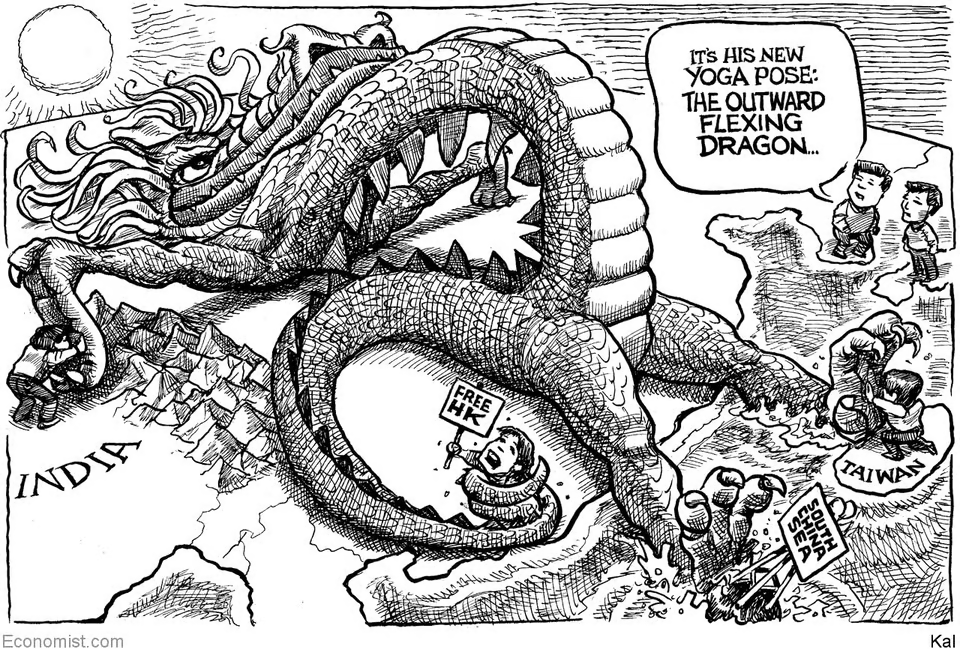
Looking at a cartoon like this, we get the message instantly, without assuming that dragons practice yoga or even exist at all. Revelation works the same way, and we can see the same elements at work in it:
- There is clearly an evil ruler set against the people of God, but chapter 21 assures us that a better time is coming with the new creation.
- The book leaves no room for compromise. It’s built entirely out of “either … or” pairs — Lamb versus Dragon, Jerusalem versus Babel, the seal of God versus the mark of the Beast, worshippers of God versus worshippers of the Beast — each pair challenging the political order and the ideology propping it up. The key point throughout is that the true king is Jesus, not the emperor; the true goal is the kingdom of God, not the Roman peace; and what’s required is faith in Jesus, not loyalty to the emperor.
Conclusion
Reading the book well means holding three things together at once. Revelation is:
- a letter that had to make sense to real people in the first and second centuries.
- a prophecy meant to encourage people to act differently right here and now — not merely at some point in the future — using strong, emotionally charged material to do it.
- an apocalypse that forces God’s people to reject compromise and oppose corrupt rulers by describing the world as an “either … or” choice.
What the book is not:
- a look into the far future (from the vantage of its ancient listeners) describing events that would have no bearing on them at all.
- a straightforward description of what the future will look like.