The use of numbers in the Book of Revelation
The book is full of numbers, but what do they actually mean? Are they literal, like the 1,260 days, or are they meant to be read some other way? To answer that, it helps to first ask how numbers function in the Bible more broadly.
Numbers are often used in Scripture to point back to an earlier story. Jesus chose 12 apostles because Israel itself was made up of 12 tribes. Israel wandered the desert for 40 years after spending 40 days examining the Promised Land in unbelief — the second 40 answering, and undoing, the first.
The number 7
The number seven is one of the most frequent symbols in the Bible.
Seven represents completeness, rooted in the seven days of creation.
The sevenfold wrath of God in the story of Cain and in the Psalms can likewise be read figuratively along these lines.
Revelation’s 7 beatitudes probably describe the entirety of the blessing given to the saints, and may even summarize the book’s whole picture of salvation.
The reference to 7 churches works the same way, expressing completeness rather than a literal headcount.
The formula “every tribe, tongue, people, and nation” occurs seven times, in varying order, to describe the totality of humanity.
The 7 seals, 7 trumpets, and 7 bowls of wrath extend this same pattern, marking out the completeness of God’s judgment.
The number 3,5
The number 4
Four is also a number of completeness, but in a more universal or worldwide sense. Revelation shows this in the four ends of the earth, in the four winds, and in the scene where creatures from the four realms of the world — heaven, earth, sea, and under the sea — sing a fourfold hymn of praise to God and the Lamb.
The earth is repeatedly divided into four parts elsewhere too: during the first trumpet, by the three angels, and in the four bowls poured on the land, sea, rivers, and sun. These same four parts become the targets of the first four trumpets and bowls of wrath, underscoring God’s judgment over the whole of creation.
The judgments’ recurring 4+3 pattern likely grows out of this same logic, and the book’s fourfold division reinforces its universal reach.
The phrase “thunder and lightning,” recalling Sinai, occurs four times at crucial turning points:
- the introduction,
- the conclusion of the seals,
- the conclusion of the trumpets, and
- the conclusion of the bowls.
The combination 4x7
If the seven thunders are counted as another series of judgments — or if the letters to the churches are read as carrying a judgmental character of their own — then the book contains 4x7 judgments altogether concerning the judgment of the whole world, echoing the Law, where the sevenfold judgment is itself repeated four times.
The sevenfold mention of the sickle points to the same completeness of worldwide judgment.
The list of the merchants' goods at Babel totals 4 times 7, or 28, goods — representing the totality of the world’s commerce. Even certain names for God and Christ follow this four-or-seven pattern:
- The One who lives 4 times, to denote Him as the eternal Creator who rules over all creation.
- God Almighty in the nominative 7 times
- He who sits on the throne 7 times.
- Christ 7 times and Jesus 14 times
- The Lamb in the sense of Jesus is expressed 4 times 7 times.
- The Lamb and God together are mentioned 7 times.
- The seven spirits are mentioned 4 times to show the fullness of divine sovereignty sent into all the world (5/6), presumably through/with the witness of the church.
There is no such pattern in Satan, the beast, or the false prophet, only in the imitation of Christ.
The number 12
Twelve likewise represents completeness, along with unity in diversity, since the people of Israel were made up of twelve tribes. The twelve apostles mirror that same pattern in the New Testament.
Twelve is squared and multiplied by 1,000 in Revelation to demonstrate completeness on an even grander scale. The number is significant enough that “twelve” itself appears twelve times in the description of the New Jerusalem, painting a picture of the end-time completeness of the saints — alongside the 3×4 gates and the 12 precious stones.
Other numbers
Word frequencies reinforce these same patterns throughout the book:
- The word “woman” (gyne) occurs 10 times, “bride” 3 times, and “saints” 14 times — each expression pointing to the church of God.
- By contrast, the counter-community “harlot” occurs 4 times, “woman” (in reference to her) 7 times, and those who dwell on the earth 10 times.
- “Babel” and “great” are each mentioned 6 times, and “woman” is used 6 times specifically of the Babylonian harlot. Six functions as the number of man, set against God, since man was created on the sixth day.
Further thoughts
Some words recur more frequently toward the end of the book, marking an intensification of their theme — “twelve,” for instance, pointing to the communion of God with the church, or “Alpha and Omega” and its equivalents marking Jesus as the story’s conclusion.
Even granting that some of these numbers or name-counts may be coincidental, the overall frequency pattern shows that numbers, too, were a deliberate way of making a statement.
A. Y. Collins argues that the numbers 4, 7, and 12 reflect a cosmic order within apocalyptic literature generally, and in Revelation especially. John uses that order to show that God stands behind everything and remains in control — the numbers form the very net in which Satan and his followers are caught, making God’s final victory both certain and visible.
Arithmetic
There’s one more aspect worth exploring: the arithmetic beauty hidden inside the book’s use of numbers.
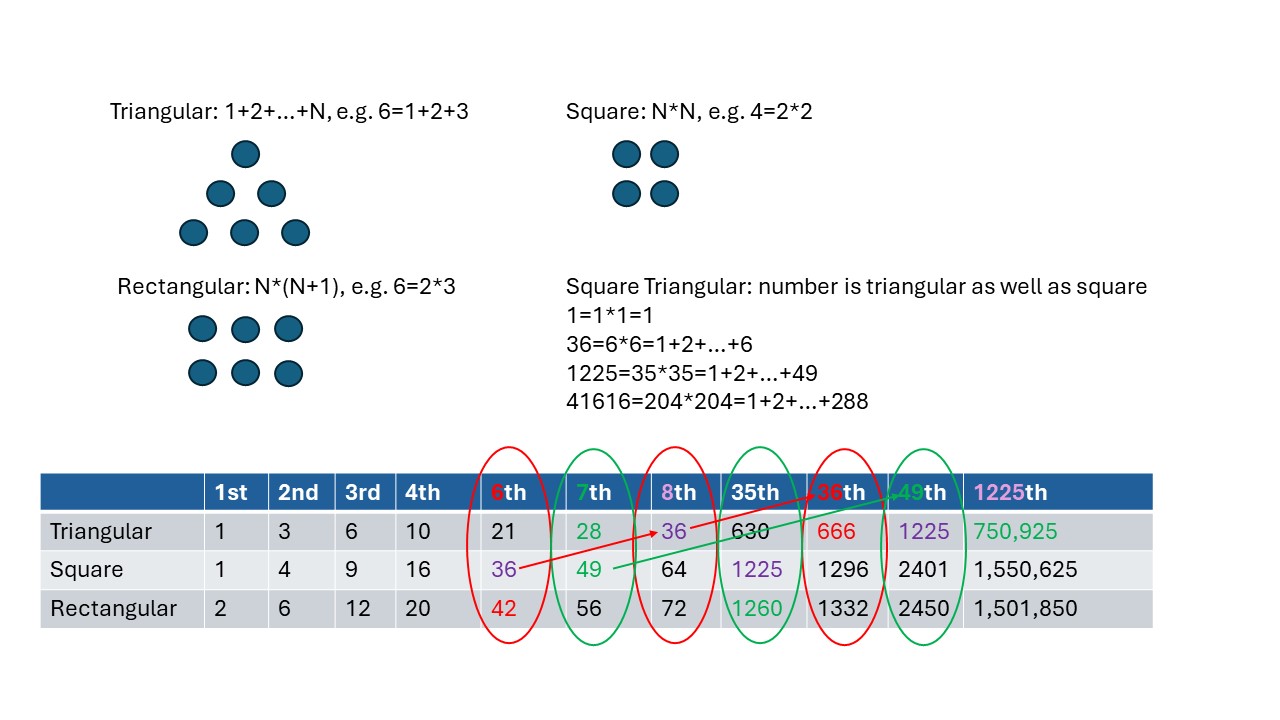
This picture illustrates triangular, square, and rectangular numbers, along with the very rare square triangular numbers. A few observations stand out.
The red-circled columns represent Satan and his kingdom, while the green-circled columns represent God and his kingdom — alternating with each other, yet always kept distinct. The lesson for us follows the same pattern: we live in this world, but there remains a real distinction between God’s kingdom and Satan’s, and the two never mix.
The smallest nontrivial square triangular number is 36, and it turns out to connect to several aspects of the beast:
- It relates to 666, the 36th triangular number, which is the mystery of the beast.
- It relates to 8, since 36 is the 8th triangular number, and 8 points to resurrection — Jesus rose on the 8th day.
- It relates to 6 — the number of man, or of power apart from God — since 36 is the square of 6.
- The 6th rectangular number is 42, matching the 42 months of the beast's activity.
The next smallest such number — and quite possibly the only other one known in John’s day — is 1,225, and it shows the same kind of pattern:
- it dwarfs 36 by comparison and takes considerably more work to arrive at.
- it is the square of 35, just one less than 36, though operating on an entirely different scale.
- the 35th rectangular number is 1,260, matching the length of time the two witnesses are active.
- it is also the 49th triangular number, and 49 is the square of 7, the number of totality or completeness.
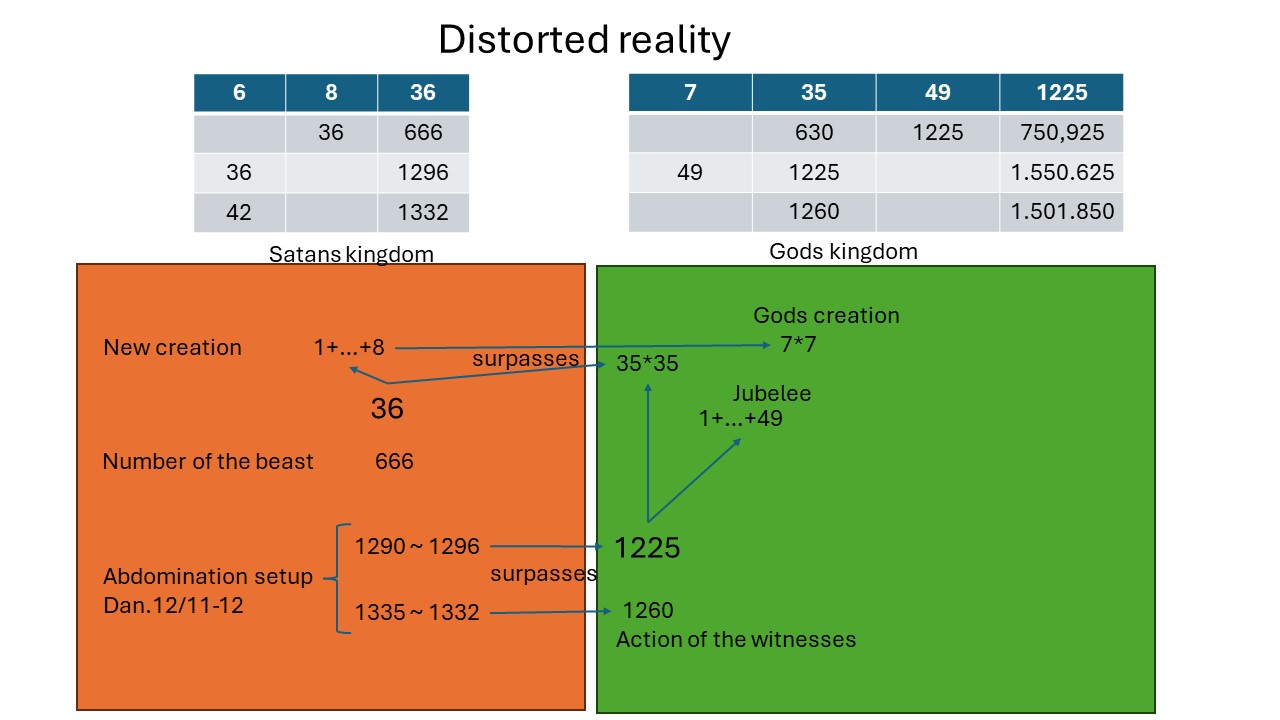
The underlying reality is that God’s kingdom towers over Satan’s, which amounts to little more than a massive parody by comparison. Take the equivalent of 666 built on 1,225 instead of 36, and you get 750.925. If we picture that ratio applied to a person 2 meters tall, Satan’s strength would compare to an insect less than 2 millimeters long.
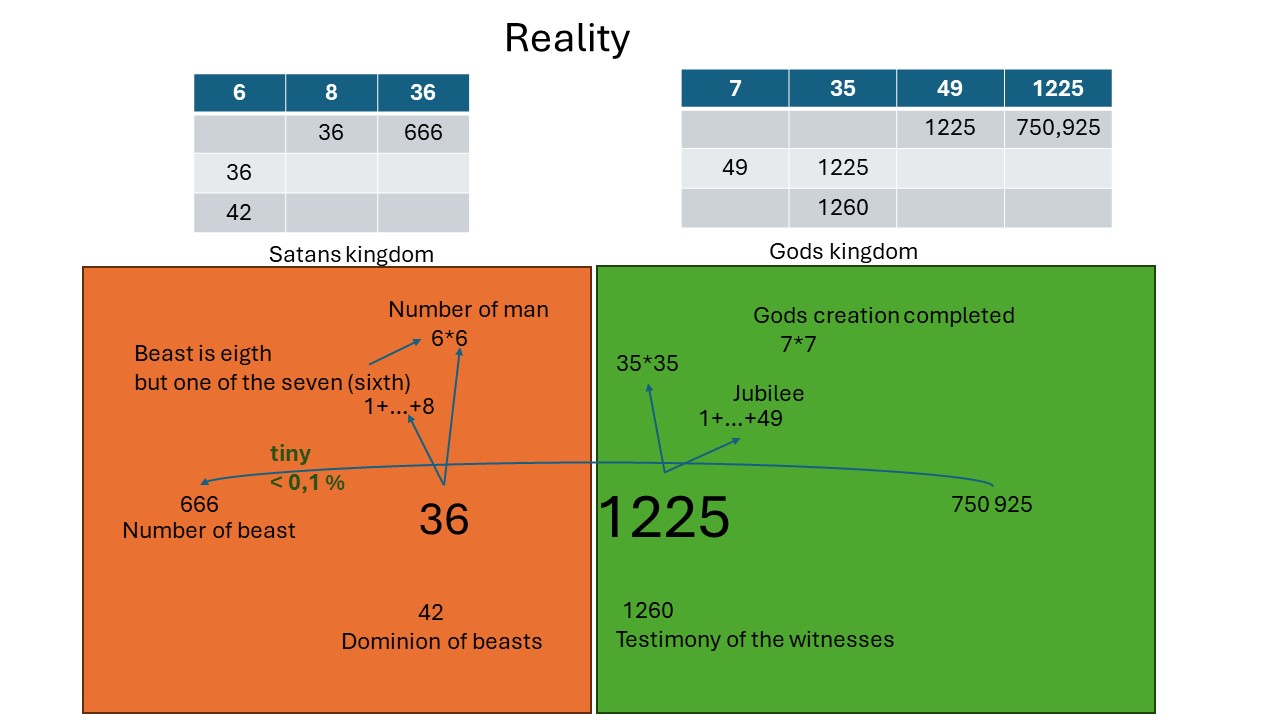
Yet what we often perceive is a distorted version of that reality, one where Satan always seems just a bit stronger than he actually is.