The 70 year weeks
The 70 year weeks are one of the most mysterious parts of the Bible, and they’ve generated no shortage of interesting interpretations about the end times. Let’s take a closer look at what this is all about.
What is a year week
At creation, God sanctified the seventh day as a day of rest, the Sabbath. That same rhythm was later extended to a “Sabbatical year”: every seventh year the land should rest, and the people were to trust that God would provide for them through it.
That never actually happened. When Israel went into exile, it was for 70 years — one year for every Sabbatical year the land had been denied, just as Jeremiah had prophesied. Since a Sabbatical year falls only once every seven years, 70 missed Sabbatical years means 7×70=490 years — the entire span of Israel’s existence as a nation up to that point. That’s why a “week” in Daniel means seven years: the term deliberately echoes the Sabbath, the seventh day of the week.
The promise
Counting 605 BC as the year the exile began brings us to 539 BC, when Babel was destroyed and the exile ended under the first Persian king. Daniel was alive at that time and knew the promise that God had made, so when the time came he prayed a prayer of repentance for his people. The answer he receives is only four verses long, but it takes some unpacking:
“‘Seventy “sevens” are decreed for your people and your holy city to finish transgression, to put an end to sin, to atone for wickedness, to bring in everlasting righteousness, to seal up vision and prophecy and to anoint the Most Holy Place. 25 ‘Know and understand this: from the time the word goes out to restore and rebuild Jerusalem until the Anointed One, the ruler, comes, there will be seven “sevens”, and sixty-two “sevens”. It will be rebuilt with streets and a trench, but in times of trouble. 26 After the sixty-two “sevens”, the Anointed One will be put to death and will have nothing. The people of the ruler who will come will destroy the city and the sanctuary. The end will come like a flood: war will continue until the end, and desolations have been decreed. 27 He will confirm a covenant with many for one “seven”. In the middle of the “seven” he will put an end to sacrifice and offering. And at the temple he will set up an abomination that causes desolation, until the end that is decreed is poured out on him.’”
“Seventy sevens” is 70×7=490 years — the same span of Sabbatical years whose neglect had sent Israel into exile in the first place.
Verse 24 lays out six things these 490 years are meant to accomplish:
- Finish transgression, for your people and your holy city. “Transgression” points to the Jews who supported Antiochus Epiphanes IV, described later in chapter 11.
- Put an end to sin — literally “seal,” which in Hebrew shares its consonants with “remove.” Either way, it’s an ambitious goal.
- Atone for all wickedness. “Atone” points back to the Day of Atonement, which in its own context was meant to cover all sins — an atonement intended to be lasting.
- Bring in everlasting righteousness.
- Seal the vision and prophecy — “seal” here in the sense of confirming it.
- Anoint the most holy place. The most holy place would naturally mean the temple, but this may point instead to Jesus, who is greater than the temple and is himself the anointed one.
Taken together, these six goals go far beyond anything achieved in history except what Jesus did on the cross: he paid for all sin, wrote God’s commandments on our hearts through the Holy Spirit, and much more besides.
The 70 years
Now let’s break down the rest of the passage. It divides the 70 weeks into three parts: 7 weeks (the decree to rebuild the temple in Jerusalem), 62 weeks (the temple actually built), and 1 final week (to finish everything).
Verse 25 reads: Know and understand this: from the time the word goes out to restore and rebuild Jerusalem until the Anointed One, the ruler, comes, there will be seven “sevens”, and sixty-two “sevens”. It will be rebuilt with streets and a trench, but in times of trouble.
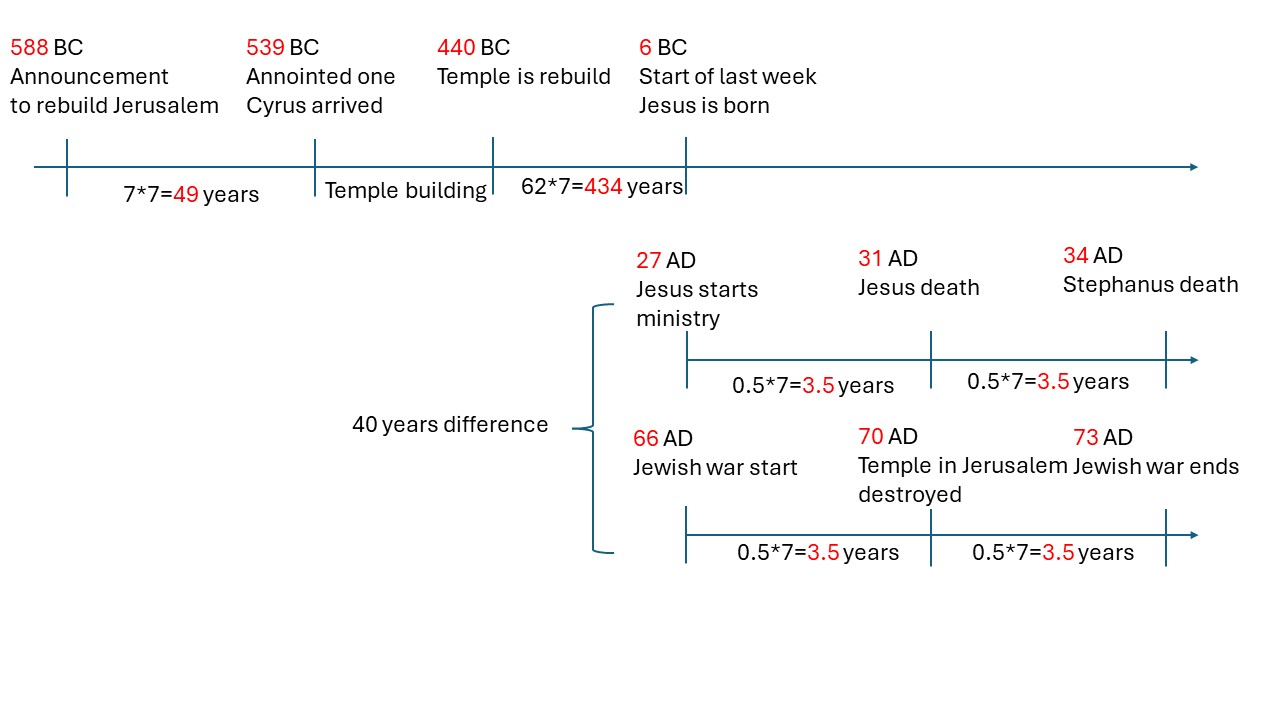
The word to rebuild Jerusalem went out through the prophet Jeremiah in 588/587 BC, during the fall of Jerusalem. That marks the start of the first 7×7=49 years, which end in 539 BC when the Anointed One, Cyrus, issues a decree to rebuild Jerusalem.
It then takes a while for the temple itself to be rebuilt — that happens under Nehemiah in 440 BC — and 62×7=434 years pass while the temple stands, though in constant trouble: Israel is pushed around from the beginning of the building through a long succession of political upheavals and changing rulers (Persians, Greeks, the Syrian-Egyptian kingdoms, and finally Rome). That brings us to 6 BC.
26 After the sixty-two “sevens”, the Anointed One will be put to death and will have nothing. The people of the ruler who will come will destroy the city and the sanctuary. The end will come like a flood: war will continue until the end, and desolations have been decreed.
Here the Anointed One is no longer Cyrus but Jesus, born in 6 BC. “Put to death and have nothing” translates an Aramaic phrase that can mean “cut off”, but can also mean “cut a covenant” — he died in order to make a covenant. “The people of the ruler” refers to the emperor Tiberius and his legions; the text uses the word “prince,” which may echo the prince of this world. That ruler’s people came and destroyed the city and the sanctuary in AD 70. The end came like a flood of Roman legions, with war continuing until Israel was finally deported from the land in AD 135 after one last uprising. The desolation, the text insists, was decreed — by God.
He will confirm a covenant with many for one “seven”. In the middle of the “seven” he will put an end to sacrifice and offering. And at the temple he will set up an abomination that causes desolation, until the end that is decreed is poured out on him.
Since the subject of that last sentence is still God from the previous clause, it’s God who confirms a covenant with many — the new covenant of Jesus.
In the middle of that final “seven,” he puts an end to sacrifice and offering, because sacrifice is no longer needed.
The subject then shifts back to Tiberius for the abomination that causes desolation (the original Hebrew doesn’t actually say “he,” but “one who makes desolate”). The text speaks of “wings” of abomination, likely referring to the Roman legionary eagle standard. “Until the decreed end is poured out on him” is better rendered “until the decreed end is put on the desolator” — meaning until the Roman Empire itself falls, which brings us back to Daniel chapter 7.
The last week
The final week — the last seven years — turns out to be more complicated, because the text seems to be telling two stories at once, each describing its own version of how things end.
The first is the story of Israel, whose Jerusalem, Temple, and land come to an end, only to be taken up into the New Covenant that Jesus establishes to start over with the Jews. The second is the story of Jesus himself. Both stories, oddly, run 40 years apart from each other. How is that possible? Jesus spent 40 days in the desert at the start of his ministry, resisting the very temptations Israel failed to resist in the wilderness after leaving Egypt — the failure that cost Israel 40 years of wandering before it ever reached the Promised Land. Here the story is turned on its head: Jesus does not give in to temptation, and by establishing a new covenant he effectively gives Israel an extra 40 years to enter it.
The story of Israel
In the year 66, the Jewish war begins. Its midpoint — three and a half years in — brings the destruction of the temple, which is never rebuilt; the sacrifices end along with it, cut off “on the wings of the destroyer.” The war itself ends in 73, seven years after it began, and after further unrest Israel is deported in 135 following one more war. By the end, Israel has lost the temple, the city, and the land.
The story of Jesus
In the year 27 — on the assumption that Tiberius’ reign began in the year 12 — Jesus is called and baptized with the Holy Spirit, and he renews the covenant with the Jews. At the midpoint of the seven years, in the year 31, he dies and rises again, and the covenant now extends to the Gentiles as well; with his death, sacrificial service is no longer necessary.
The seven years end in the year 34, the year Stephen is presumably stoned to death after a speech accusing Israel of having abandoned its covenant. This is the first time after Jesus’ death that a Christian dies for the faith, and it’s also the first mention of Paul, who will go on to spread the faith vigorously among non-Jews.
This is the moment the church begins to follow Jesus in full — the new covenant is now genuinely active.