The Harlot in Revelation: A mocking of the Roman Empire
The story of the harlot Babylon in Revelation is one of the most layered in the book, and it leans heavily on subtle irony aimed at the Roman Empire. Ready for it?
The coin
Start with a coin that would have been common currency at the time.
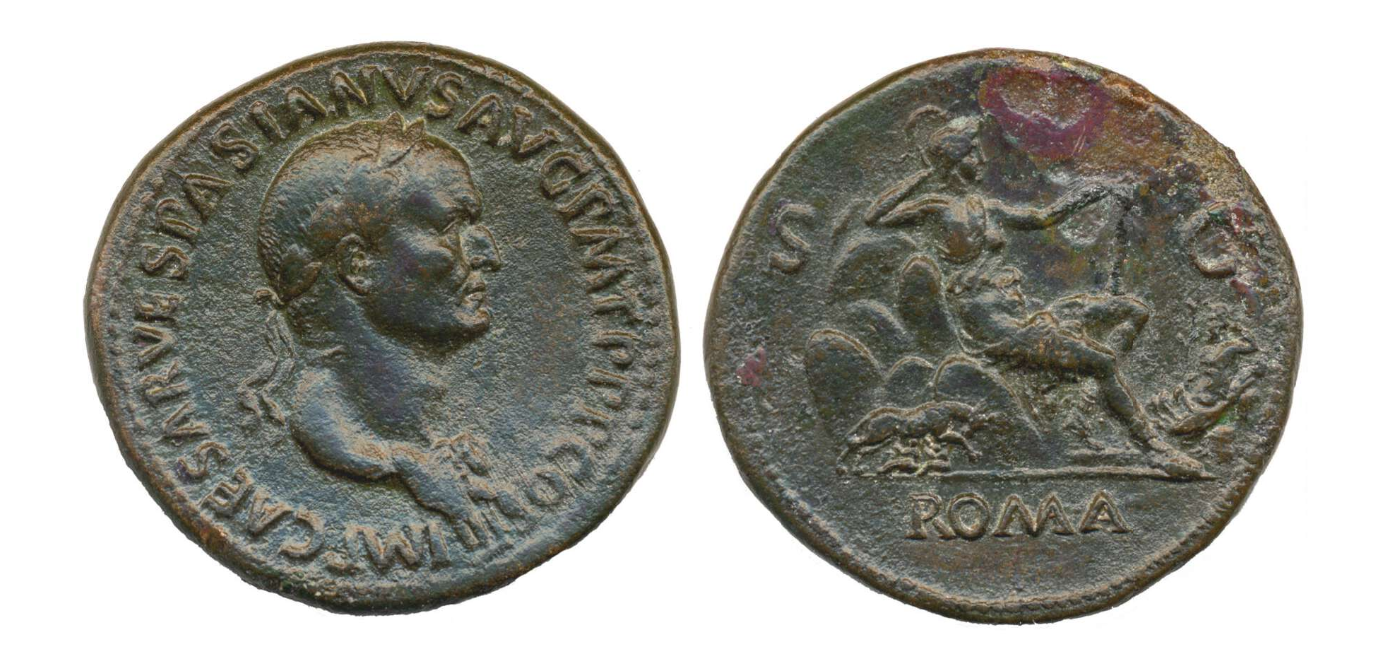
On the obverse is Emperor Vespasian (reigned 69–79) with the inscription “Imp Caesar Vespasianus Aug P M TR P P P COS III” — “Emperor Caesar Vespasian Augustus, Pontifex Maximus (Greatest Priest), Tribunicia Potestas (Tribunal Power), Pater Patriae (Father of the Fatherland), Consul for the third time.” In short, a résumé of the emperor’s power and achievements.
The reverse shows the goddess Roma in military dress, seated on the seven hills of Rome, a small sword resting on her knee as a symbol of Rome’s military power. To her left and right is the abbreviation SC (Senatus Consultum, “by decree of the Senate”).
On the right, a male figure representing the river Tiber, which surrounds Rome, bows before Roma. In the lower left, a she-wolf nurses Romulus and Remus, recalling Rome’s traditional founding legend — the city’s own dating, by the Roman antiquarian Varro, to 753 BC, and its self-told descent from Trojan refugees via Romulus and Remus. At the very bottom is the word Roma — possibly a nod to Rome’s tradition of a “secret name,” Amor, which reversed spells “love” (a tradition echoed, among other places, in the late-antique commentary of Servius on Virgil’s Aeneid).
So the reverse of the coin is a straightforward celebration of Rome’s power and permanence. What does Revelation do with that same imagery?
- Describing a woman as a wolf was, even in ordinary Latin, a way of calling her a prostitute — and the secret name Amor only sharpens the insult.
- The goddess of Rome is recast here as a harlot — not just any harlot, but the mother of all harlots.
- The hills of Rome, rather than supporting her, become the beast and the kings who destroy her: Roma ends up the victim of the very city she was meant to protect.
- And instead of protecting herself from enemies with her sword, she is covered in the blood of the saints.
The coin’s celebration of the Pax Romana is turned, point by point, into an image of contempt and disgust — a reminder to every believer who handled that coin in daily life that Rome could not be trusted. It’s remarkably effective counter-propaganda.
This is not an isolated rhetorical move. “Babylon” itself is a recognized code name for Rome in Jewish and early Christian writing of the period — most clearly in 1 Peter 5:13, and also in works like 2 Baruch, 4 Ezra, and Sibylline Oracles 5. Babylon had destroyed Solomon’s temple in 586 BC; Rome destroyed the Second Temple in 70 AD. Calling Rome “Babylon” placed it inside that same typological pattern of a proud pagan empire that destroys God’s temple and, in turn, faces God’s judgment.
The Ekphrasis
The first half of chapter 17 is the only part of Revelation where an angel interprets a static picture for the reader. Even in chapter 21, describing the New Jerusalem, the angel simply shows without explaining, and the scene is full of motion — the city comes down, water flows, trees bear fruit. Chapter 17, by contrast, is a frozen tableau, and the whole focus is on understanding the prostitute by way of the beast she sits on.
The passage is written in the style of an ekphrasis, a rhetorical description of a work of art (though the form could also describe people or festivals). The genre’s most famous example is the description of the shield of Achilles in the Iliad.
Ekphrasis was popular in Rome from the first century BC on, and its central device is a bewildered narrator — because the point was either to deepen the reader’s understanding of the picture, or to reveal a hidden meaning that’s genuinely hard to decipher, as in the “Tabula of Cebes,” one of the best-known examples of this particular allegorical-ekphrasis tradition.
That tabula may well be a source behind Revelation 17. It describes a crowd looking at a picture on a dedication plaque in a temple, unable to make sense of it, until an old man arrives and explains it to them (see chapter 8):
- Life is pictured as three rings separated by walls.
- The goal is to reach the middle ring, a kind of Garden of Eden reachable only by overcoming distractions like wealth and indulgence, and by practicing virtues like temperance and fortitude.
- A great crowd wants to get in.
- At the first gate stands a woman offering a cup to everyone. Her name is Deception; the drink is Error and Lack of Knowledge.
Another possible parallel is the Odes of Solomon 38:9–14, where Error and Lack of Knowledge disguise themselves as the bride and groom at a wedding, and the wine there makes the guests vomit up their own understanding.
Both parallels point to the same purpose behind the ekphrasis in Revelation 17: understanding this deception is the first step toward God’s kingdom. If Rome has deceived you, there’s little hope left for you — and yet the deception is so brazen that it’s meant to be hard to miss.