The dragon and the two beasts (Ch. 13)
Chapter 13.
Satan is defeated - everything he attempted in chapter 12 failed. Now, with nothing left to lose, he turns his attention to the church, attacking on two fronts at once: brute force and persecution, and deception.
The deception is the more revealing of the two. The dragon, joined by a beast from the sea and a beast from the earth, forms a dark parody of God, Christ, and the Holy Spirit - each mimicking real power and authority, a kind of resurrection, and miraculous signs. In their first-century setting, this pointed directly at Rome: an empire that demanded worship of the emperor as a living god, backed by a religious propaganda machine (the second beast) that made the whole system look sacred.
However convincing the counterfeit looks at first, the differences are decisive. Jesus rules through love, in apparent weakness, willing to be rejected. Satan’s system rules through fear, manipulation, persecution, and death, and can never afford to show weakness at all.
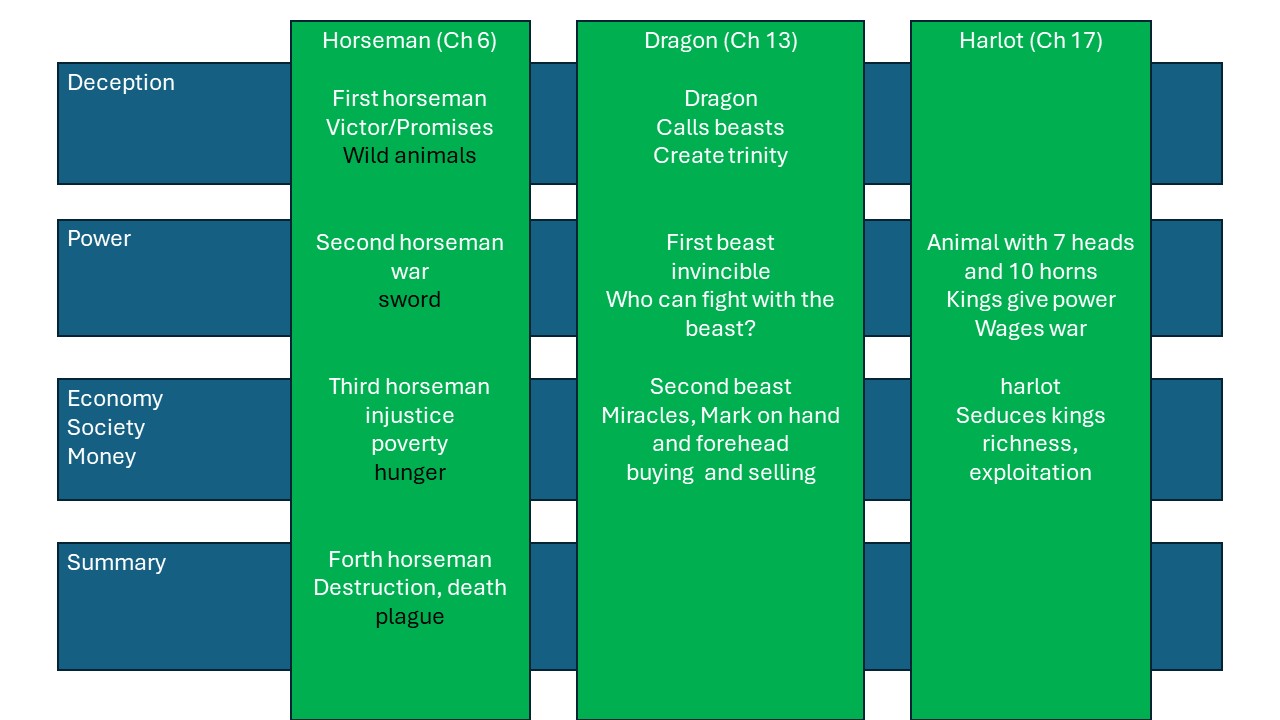
That contrast is exactly what should distinguish the church from everyone taken in by the counterfeit: not greater power, but a willingness to love without needing fear or manipulation to back it up.
The second beast is described with “two horns like a lamb, but it spoke like a dragon” (Revelation 13:11) - close enough to the real Lamb to fool almost everyone. The one thing that gives it away is its voice - and only those who already know Jesus’ voice can tell the difference.
As for the number 666: rather than a code naming one specific future individual, it functions as Revelation’s own verdict on this whole counterfeit trinity - one short of the completeness represented by 777, a spectacular, three-times-repeated failure.
Key images
- The image of the beast - the statue of the emperor that everyone was expected to honour: loyalty made visible, and refusing it made you a traitor.
Read the fuller explanation → · The beasts in their historical setting →