The letters to the churches (Ch. 2-3)
Chapter 2 and 3.
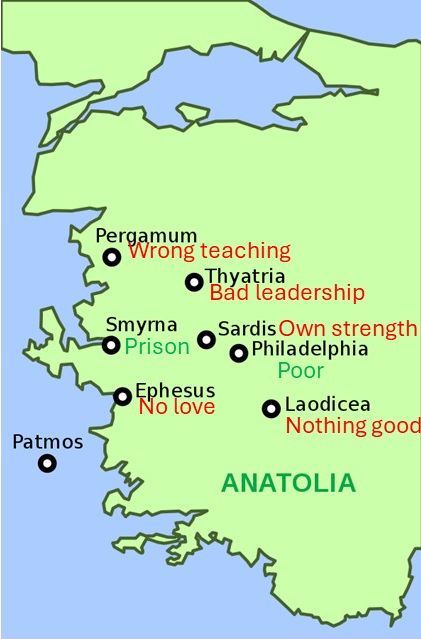
Jesus now measures each of the seven churches against the vision from chapter 1 - and the results are mixed. Only two churches receive nothing but praise: Smyrna and Philadelphia, both suffering under persecution or poverty. Two receive no praise at all: Ephesus and Laodicea. The rest fall somewhere in between.
The seven are arranged in a deliberate, symmetric pattern:
- Ephesus - total failure: lost its first love
- Smyrna - praised without reservation: faithful in persecution
- Pergamon - the problem starts: false teaching tolerated
- Thyatira - the center, and the warning: the problem is the leadership itself
- Sardis - a reputation for life, but actually dead
- Pergamon - the problem starts: false teaching tolerated
- Philadelphia - praised without reservation: faithful in poverty and weakness
- Smyrna - praised without reservation: faithful in persecution
- Laodicea - total failure: lukewarm and self-satisfied
Jesus always begins with genuine praise before he corrects.
Ephesus
Ephesus did everything right - sound doctrine, hard work, endurance - but lost its love, and Jesus warns their lampstand will go dark unless they return to it.
The promise: to eat from the tree of life - the intimacy with God that was lost in Eden, and that the book returns to on its last page.
Smyrna
Smyrna, poor and persecuted, is told simply to stay faithful, even to death - Jesus, himself risen from death, is their example.
The promise: the second death will not touch them - the final death, after the resurrection, has no claim on those who died faithful.
Pergamon
Pergamon’s leadership let compromising teaching (echoing Balaam’s seduction of Israel) creep in unchallenged.
The promise: hidden manna and a white stone with a new name - God’s own provision instead of the meat of the idol feasts, and a white stone as the token of acquittal, or the pass that lets you in to the wedding supper.
Thyatira
Thyatira, though probably the smallest church, gets the longest letter because its own leadership (“Jezebel”) is actively leading people into idolatry.
The promise: authority over the nations, and the morning star - a share in Christ’s rule, and the dawn of a new hope, which is Jesus himself.
Sardis
Sardis looks alive but is spiritually dead - only a few who “have not soiled their clothes” are commended.
The promise: white garments, and a name that will never be erased from the book of life - purity kept from compromise, and an inheritance stated as a guarantee: not erased, because it was written there in the first place.
Philadelphia
Philadelphia, weak and under social and economic pressure, is promised an open door no one can shut.
The promise: to be a pillar in God’s temple, with his name on them - never again shut out of his presence, in the city they were excluded from.
Laodicea
Laodicea’s wealth has made it blind to its own poverty - “lukewarm” describes a church that is useless for any purpose, neither refreshing like cold water nor healing like hot water.
The promise: to sit with Jesus on his throne - a share in his rule, given to those who overcome the same pressure to compromise that he overcame.
Key images
- The Nicolaitans - a group inside the church teaching that joining the idol feasts was harmless — the same failure Balaam once led Israel into.
- The synagogue of Satan - not the Jewish people, but those in Smyrna and Philadelphia who handed believers over for refusing to worship the emperor.
Read the fuller explanation and each individual letter →